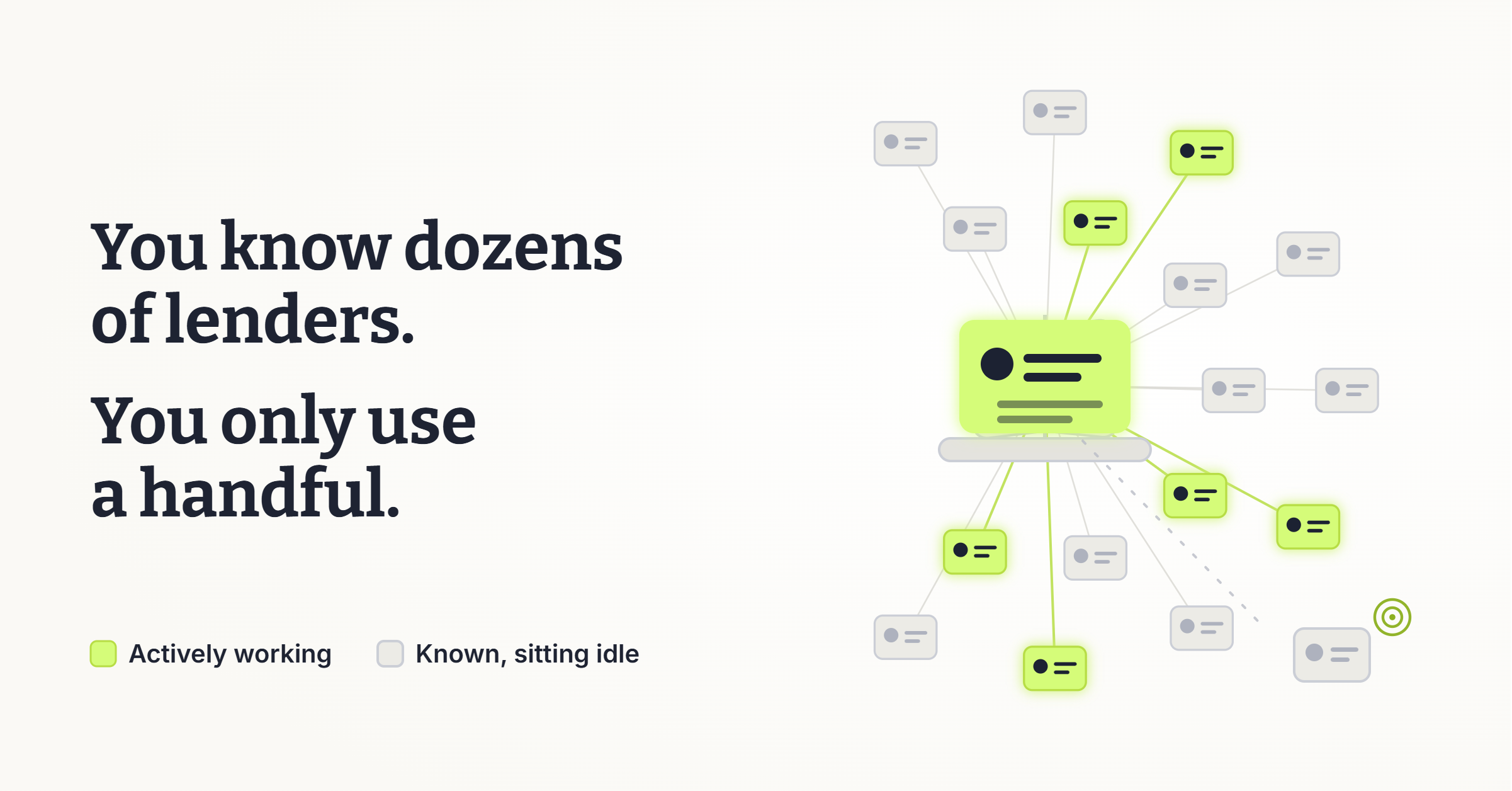
Marcus had been brokering commercial deals for fourteen years. Good at the job. Deep relationships. A network most brokers would envy. But ask him which of his forty-three lenders was actively doing small-balance multifamily in Charlotte right now and he’d pause. He knew them. He just couldn’t say, with confidence, what they were doing this week.
So when a deal landed that fit that box exactly, he sent it to the same six names he always used. Not because they were the best fit. Because they were the ones he remembered fastest. The right lender was in his contacts. Never got the call. This isn’t a failure of effort.
Marcus built those relationships the hard way. Conferences. Closing tables. Years of honest work. The problem wasn’t the relationships. It was that nothing held what each lender was actually doing right now. So a person ended up holding it instead.
And people go home at six. They forget updates. They can’t be in two deals at once.
The moment someone’s out sick or slammed on another file the whole pipeline slows down with them.
A lot of brokers assume their CRM solves this.
It doesn’t. And it’s worth being specific about why.
A CRM is genuinely good at one job: remembering who someone is. Name, title, last call, notes. It was never built to track what a lender is actually lending on this month. Programs shift. Leverage tightens. Geography opens and closes. None of that shows up on a contact card, no matter how well maintained it is. Dealpath’s breakdown of CRM limitations for commercial real estate teams makes the same point directly.
The cost of this rarely feels dramatic.
It shows up as the deal that went to the lender you happened to remember instead of the one who actually fit. It shows up as thirty relationships that never get used, because nobody can verify they’re still active without picking up the phone.
Over a full year, across a real pipeline, that adds up. MBA’s Commercial/Multifamily Research puts total CRE lending at roughly $706 billion in 2025 alone a lot of deal flow to be routing on memory. Not as one dramatic loss. As dozens of quiet ones.

The fix isn’t a sharper memory or a better notebook.
It’s a place that holds every lender relationship you have, not just the handful you remember, and keeps what each one is currently lending on up to date automatically. So when a deal lands, it matches on current fit. Not last week’s phone call.
Hard work builds relationships. It doesn’t maintain them at scale on its own. That’s not a knock on anyone’s work ethic. It just takes infrastructure most brokers have never had access to before.
See how the matching actually works: Watch a demo.